The Age-Well Project

Change the way you age

Get our posts direct to your inbox

Search

  • About The Age-Well Project
  • Books
    • Our Books
    • Reviews
    • References
  • Blog
  • Recipes
    • Recipes By Ingredient
    • Breakfast
    • Dessert
    • Dinner
    • Drinks
    • Family
    • On The Go
    • Soups and Salads
    • Treats and Snacks
  • Contact
  • Events
  • Press

THE FUTURE OF FOOD AND SMASHED CUCUMBER SALAD

July 20, 2018 4 Comments

I’ve seen the future and it’s looking good! If we look after our health, we look after the  planet too – how great does that sound? Lots of positive vibes here at The Age-Well Project this week.

I attended a fascinating panel discussion this week about the future of food: put simply, we need to find the sweet spot where saving the planet, and improving our health, intersect. Food production has a huge impact on both the health of the earth, and our own wellbeing.

The panel consisted of two environmental campaigners and two gut-health experts. They had very different approaches, but everyone ended up in pretty much the same place.

Talking gut health were Alana and Lisa MacFarlane, aka The Mac Twins, gorgeous 20-something DJs who were the “chief guinea pigs” for Tim Spector’s TwinsUK research at King’s College London. As identical twins, their DNA is exactly the same. But – and get this, gut geeks – only around 40% of their microbiome is identical. If that doesn’t tell you that every microbiome is completely individual, I don’t know what does! The twins co-founded a website, The Gut Stuff, to spread the word about healthy intestines. Their aim, likes ours, is  to bridge the gaps between academia and real humans: to help people make sense of scientific research about health.

Focussing on the impact of food production on the planet was environmentalist Tristram Stuart, who campaigns against food waste through the charity Feedback. He pointed out that one-third of food is wasted. How insane is that? Joining him was scientist and farmer Abi Aspen Glencross from The Sustainable Food Story who grows heritage grains and spreads the word about environmental health through supper clubs and events.

The environmentalists spoke out against monoculture and the huge corporations which profit from industrialised farming. Nature thrives best on diversity and variety. And so, of course, do we. For our gut health, we need to eat up to 30 different varieties of vegetables and fruit each week. The Mac Twins explained that on average we eat around six.

We all need to make small changes to our eating habits, adding a new vegetable or type of fruit to our diets: change doesn’t need to be drastic. And by diversifying the fruit and veg on our plates, we show farmers that it’s worth growing a wider range of crops. The more variety there is, the better it is for all of us.

Everyone agreed that we need to learn how our food choices impact the planet and how to think critically about information we receive. It’s about allowing people to make educated choices to give us, and the planet, the best possible future. All of which we endorse wholeheartedly here at The Age-Well Project.

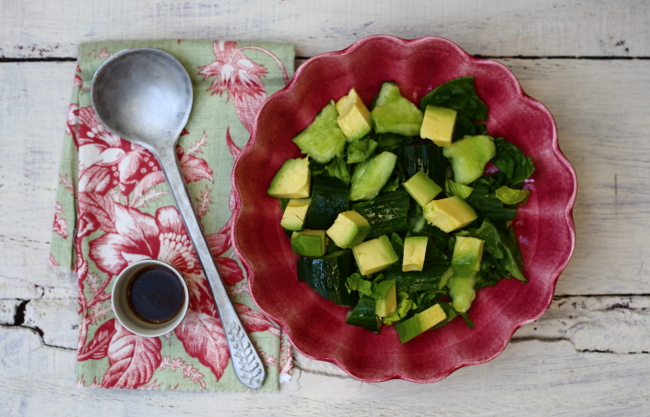
In the spirit of getting more vegetables into our lives, this week’s recipe takes an everyday salad staple – cucumber – and serves it in a whole new way. This method, and recipe, were taught to me by my Chinese ‘sister’. It’s very popular in China. Trust me, once you’ve eaten the cucumber in this salad you’ll never want to eat it in pathetic, watery slices again. Smashed up like this, it’s a whole new vegetable.

SMASHED CUCUMBER SALAD (serves 4 as a side dish)

  • 1 whole cucumber
  • 1 ripe avocado
  • 2 handfuls of lettuce leaves

For the dressing:

  • 1 clove of garlic, peeled and finely chopped
  • 2 tbs rice vinegar
  • 1 tbs soy sauce
  • 4 tbs olive oil

Mix the dressing ingredients in a small bowl and put to one side. You will probably have more than you need but any leftover dressing keeps well in the fridge.

Now, this is the fun part. Place the cucumber on a chopping board and make sure that nothing too precious is nearby. Grab a rolling pin and bash the cucumber all over. It will start to crack. Keep going until it’s flattened and stray bits of the central, watery, core are flying around. Following the cracks, rip the cucumber into chunks using your hands. Run your thumb nail along the core as you go to dislodge the seeds. Throw the chunks into a salad bowl and discard the soggy mass of seeds you have left on the chopping board.

Peel and cube the avocado and shred the lettuce leaves. Add both to the salad bowl and gently mix in some of the dressing.

This goes with just about anything.

Susan

  • Meal Types: Dinner
« HOW TO CREATE A BODY THAT REPELS CANCER & MISO SALMON TRAY BAKE
GREEN SPACE IS GOOD FOR YOUR HEALTH »

Comments

  1. Heather Mitchell says

    July 20, 2018 at 5:55 pm

    We have a glut of cucumbers at the moment and have been making Gazpacho, Raita and Lassi. So will give this a try tomorrow but I think it will be safer to do it out in the garden rather than splattering our kitchen with the cucumber. Really enjoy your recipes and blogs. Many thanks.

    Reply
    • Susan Saunders says

      July 20, 2018 at 8:36 pm

      Thanks so much Heather – glad you like them! Do give the salad a go – it’s not too messy, and fun to make!

      Reply
  2. hilary defriez says

    July 20, 2018 at 7:24 pm

    I fear the issue isn’t just about variety, the 30 different fruits/vegetables a week. A major problem for the planet and our guts is the way food is produced. What is the point in eating a huge variety if at the same time we are consuming toxins from pesticides and chemical fertilisers? These are far more damaging, and not only to the gut, than a more limited range of foods, grown organically.

    Reply
    • Susan Saunders says

      July 20, 2018 at 8:37 pm

      Really interesting point, thanks Hilary

      Reply

Leave a Reply Cancel reply

Your email address will not be published. Required fields are marked *

This site uses Akismet to reduce spam. Learn how your comment data is processed.

  • Email
  • Facebook
  • Instagram
  • Twitter

Welcome to The Age-Well Project

Welcome to The Age-Well Project!
Here you’ll find easy changes for a longer, happier life. We’ve immersed ourselves in the science of longevity and distilled the research to make it work in our everyday lives. You can change the way you age: here’s how.

The Age Well Project Book
The Age Well Project Plan
Windswept why women walk
52 ways to walk
the power decade
sleepless
the walking cure

Favourite Posts

WHY I’VE THROWN OUT ALL MY BEAUTY PRODUCTS (nearly…)

Why Alzheimer’s Is A Women’s Issue

HOW HAVING A DOG CHANGED MY LIFE

GREEN SPACE IS GOOD FOR YOUR HEALTH

SUGAR, CHOCOLATE, SADNESS AND BRAIN-BOOSTING BISCUITS

WHY ‘INFLAMM-AGEING’ COULD START IN THE GUT AND HARISSA-ROASTED VEGETABLE SALAD

POLYAMINES – THE NEW SECRET WEAPON FOR AGEING WELL & MOROCCAN SPINACH AND CHICKPEAS.

THINNING AGEING HAIR – WARM CHICKEN LIVER SALAD

About The Age Well Project

This site is for anyone who wants to make the second half of their life as healthy, happy and disease-free as possible. Sign up to get the latest research on ageing – and delicious recipes to match – direct to your inbox.

agewellproject

⭐️Change the way you age
📚The Age-Well Project + Age-Well Plan ⭐️Get tips & recipes on our blog - sign up ⬇️

A really fun evening @putneywaterstones talking ab A really fun evening @putneywaterstones talking about Annabel’s book The Walking Cure and all things Age Well! 💚
We’ve always been a little wary of brain training We’ve always been a little wary of brain training exercises. There’s certainly plenty of them out there. They’re well researched, but the ultimate conclusion is often that they make you really good at playing that particular game with no substantial real-world benefits.
We’d usually rather read a book, play a board game or do a puzzle for a little cognitive sharpening. 

But new research linked specific cognitive training designed to improve speed of processing to a 25% lower risk of developing dementia across 20 years, compared to the control group. 

There’s more on the blog - link in stories and agewellproject.com 

#longevityblog #womeonover50 #braintraining
You’ll have heard that sitting is the new smoking, You’ll have heard that sitting is the new smoking, our sedentary lifestyles are killing us etc etc 

But is all sitting equally bad? it appears not. ‘Active sitting’ - where we’re engaged in a brain-healthy activity like reading or playing stimulating games, doesn’t have the same detrimental impact as slumping in front of the TV. 

It’s what we do when we’re sitting that counts. 

There’s more on the blog - linked in stories 

 #longevityblog #womenover50 #agewell
It is - finally - starting to get a little lighter It is - finally - starting to get a little lighter in the UK. 

But our lives are still full of artificial light, causing our body clocks to drift. The end result? Circadian disruption linked to higher risk of metabolic syndrome, cardiovascular disease, depression, and cognitive decline.

That light-dark imbalance also results in worse sleep and therefore also potentially poorer glymphatic clearance (the brain’s overnight clean up).

But there’s so much we can do to bring light into our lives - at any time of year.

There’s more on the blog - link in stories and agewellproject.com 

And are you enjoying the lighter mornings?! 

#longevityblog #womeonover50 #agewell
Some of our favourite activities - reading books, Some of our favourite activities - reading books, drinking tea, eating cheese (yes, we know how to live!) - have been linked to a longer, better life. 

A new study suggests that cheese  can lower our dementia risk – although no one is quite sure how or why. This new study found that eating 50 grams (1.76 ounces) or more of high-fat cheese a day correlated with a lower risk of developing dementia.

A recent summary  of previous studies which concluded that regular reading improved brain connectivity and function, consolidating neural connections and enhancing brain connectivity, while also improving memory and concentration and slowing down cognitive decline.

And a study published just before Christmas found that tea-drinking protects against osteoporosis.

All good things! There’s more on the blog - linked in stories 

#longevityblog #agewell #womenover50
Follow on Instagram

Contact Us

For any enquiries please email theagewellproject@gmail.com.

Copyright © 2026 The Age-Well Project