The Age-Well Project

Change the way you age

Get our posts direct to your inbox

Search

  • About The Age-Well Project
  • Books
    • Our Books
    • Reviews
    • References
  • Blog
  • Recipes
    • Recipes By Ingredient
    • Breakfast
    • Dessert
    • Dinner
    • Drinks
    • Family
    • On The Go
    • Soups and Salads
    • Treats and Snacks
  • Contact
  • Events
  • Press

WHY WE ARE NUTS ABOUT NUTS – AND A RECIPE FOR ALMOND-GINGER DIPPING SAUCE

July 11, 2014 Leave a Comment

nuts-and-carrots

Eating well to age well (our Kale and Cocoa mantra) isn’t about the odd sprinkle of chia seeds and goji berries (although we love them both) – it’s about making real change to how we eat: whacking up the amount of vegetables and fruit, reducing processed, refined foods and focussing on foods that do us good. Near the top of my list of great pro-ageing foods are NUTS . They’ve got it all: fibre, vitamins, minerals and natural oils to keep our hearts healthy, brains powering and skin glowing.

A study at the Harvard School of Public Health, published in New England Journal of Medicine showed ‘daily nut eaters were less likely to die of cancer, heart disease, and respiratory disease.’ The Harvard researchers suggested that the composition of nuts—may provide “cardio-protective, anti-carcinogenic, anti-inflammatory, and antioxidant properties.” It is thought the fats in nuts (and let’s not pretend they are a low-calorie food) lower bad cholesterol levels. The Omega-3 fatty acids help the heart, as do the high levels of vitamin E, plant sterols and L-arginine – believed to keep artery walls flexible.

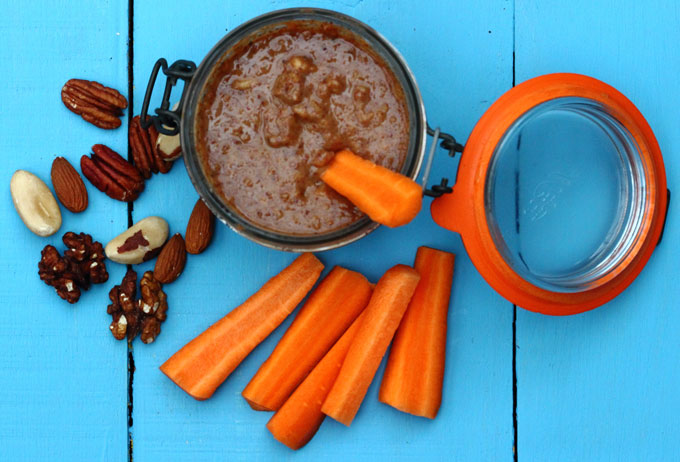
While all good for your heart, different nuts have different health benefits. Brazils are high in selenium which supports healthy thyroid function and the immune system: I keep a tub in the larder to snack on. Three or four provide all the selenium we need each day. Pistachios – quite apart from looking beautiful – are rich in vitamin B6, which keeps hormones balanced, and contain lutein: an antioxidant that plays an important role in protecting the eyes. Recent research found they also reduce the risk of diabetes. I sprinkle them, chopped, over salads and porridge. Walnuts contain high levels of Omega-3 for brain and skin health. I toast them and make pesto (recipe coming in a couple of weeks). But my Number One nut is the almond. Rich in calcium, they prevent osteoporosis – a major concern for ageing women. I put almond milk on my breakfasts (I love the Blue Diamond brand, unsweetened) and am borderline obsessed with crunchy almond butter – a million times better than the peanut version – which I fell in love with in Toronto, and recently found in my local Little Waitrose (made by Meridian Foods). I use it to make this sauce/dip – for crudities, daubed onto steamed veg, thinned down as a salad dressing or stirred through noodles. The latter is one of my children’s favourite meals – topped with grated carrots, edamame beans and cucumber, they don’t even notice how healthy it is!

CRUNCHY ALMOND-GINGER DIPPING SAUCE (serves four, makes one small jar)

125g crunchy almond butter (or peanut, if you prefer)

2tbs hot water – approximately, depends how much you want to thin this down

1tbs soy sauce

1tbs minced ginger

1 clove garlic, minced

1tbs maple syrup

Pinch of cayenne or chilli powder

1tbs white wine vinegar

Simply stir all the ingredients together. You may need more warm water to slacken the mixture. Taste to see if you have the balance of flavours right (I like it a little sharper so often add a splash more vinegar) and enjoy. This keeps for at least a week in the fridge.

Susan


  • Meal Types: Family, Soups and Salads, Treats and Snacks
  • Conditions: Bones, Heart disease
  • Ingredients: Almonds, Nuts
« WHY WE SHOULD ALL BE EATING MORE WATERMELON – WATERMELON SALAD WITH FETA AND PUMPKIN SEEDS
CANCER-BUSTING CARROTS AND A SIMPLE CARROT SALAD WITH SESAME DRESSING »

Leave a Reply Cancel reply

Your email address will not be published. Required fields are marked *

This site uses Akismet to reduce spam. Learn how your comment data is processed.

  • Email
  • Facebook
  • Instagram
  • Twitter

Welcome to The Age-Well Project

Welcome to The Age-Well Project!
Here you’ll find easy changes for a longer, happier life. We’ve immersed ourselves in the science of longevity and distilled the research to make it work in our everyday lives. You can change the way you age: here’s how.

The Age Well Project Book
The Age Well Project Plan
Windswept why women walk
52 ways to walk
the power decade
sleepless
the walking cure

Favourite Posts

WHY I’VE THROWN OUT ALL MY BEAUTY PRODUCTS (nearly…)

Why Alzheimer’s Is A Women’s Issue

HOW HAVING A DOG CHANGED MY LIFE

GREEN SPACE IS GOOD FOR YOUR HEALTH

SUGAR, CHOCOLATE, SADNESS AND BRAIN-BOOSTING BISCUITS

WHY ‘INFLAMM-AGEING’ COULD START IN THE GUT AND HARISSA-ROASTED VEGETABLE SALAD

POLYAMINES – THE NEW SECRET WEAPON FOR AGEING WELL & MOROCCAN SPINACH AND CHICKPEAS.

THINNING AGEING HAIR – WARM CHICKEN LIVER SALAD

About The Age Well Project

This site is for anyone who wants to make the second half of their life as healthy, happy and disease-free as possible. Sign up to get the latest research on ageing – and delicious recipes to match – direct to your inbox.

agewellproject

⭐️Change the way you age
📚The Age-Well Project + Age-Well Plan ⭐️Get tips & recipes on our blog - sign up ⬇️

A really fun evening @putneywaterstones talking ab A really fun evening @putneywaterstones talking about Annabel’s book The Walking Cure and all things Age Well! 💚
We’ve always been a little wary of brain training We’ve always been a little wary of brain training exercises. There’s certainly plenty of them out there. They’re well researched, but the ultimate conclusion is often that they make you really good at playing that particular game with no substantial real-world benefits.
We’d usually rather read a book, play a board game or do a puzzle for a little cognitive sharpening. 

But new research linked specific cognitive training designed to improve speed of processing to a 25% lower risk of developing dementia across 20 years, compared to the control group. 

There’s more on the blog - link in stories and agewellproject.com 

#longevityblog #womeonover50 #braintraining
You’ll have heard that sitting is the new smoking, You’ll have heard that sitting is the new smoking, our sedentary lifestyles are killing us etc etc 

But is all sitting equally bad? it appears not. ‘Active sitting’ - where we’re engaged in a brain-healthy activity like reading or playing stimulating games, doesn’t have the same detrimental impact as slumping in front of the TV. 

It’s what we do when we’re sitting that counts. 

There’s more on the blog - linked in stories 

 #longevityblog #womenover50 #agewell
It is - finally - starting to get a little lighter It is - finally - starting to get a little lighter in the UK. 

But our lives are still full of artificial light, causing our body clocks to drift. The end result? Circadian disruption linked to higher risk of metabolic syndrome, cardiovascular disease, depression, and cognitive decline.

That light-dark imbalance also results in worse sleep and therefore also potentially poorer glymphatic clearance (the brain’s overnight clean up).

But there’s so much we can do to bring light into our lives - at any time of year.

There’s more on the blog - link in stories and agewellproject.com 

And are you enjoying the lighter mornings?! 

#longevityblog #womeonover50 #agewell
Some of our favourite activities - reading books, Some of our favourite activities - reading books, drinking tea, eating cheese (yes, we know how to live!) - have been linked to a longer, better life. 

A new study suggests that cheese  can lower our dementia risk – although no one is quite sure how or why. This new study found that eating 50 grams (1.76 ounces) or more of high-fat cheese a day correlated with a lower risk of developing dementia.

A recent summary  of previous studies which concluded that regular reading improved brain connectivity and function, consolidating neural connections and enhancing brain connectivity, while also improving memory and concentration and slowing down cognitive decline.

And a study published just before Christmas found that tea-drinking protects against osteoporosis.

All good things! There’s more on the blog - linked in stories 

#longevityblog #agewell #womenover50
Follow on Instagram

Contact Us

For any enquiries please email theagewellproject@gmail.com.

Copyright © 2026 The Age-Well Project